Ansel's featured in July's issue of GQ, modeling the latest in menswear fashion!


Source Via LadyofErudite


We've just arrived for the #GlamourAnsel Twitter takeover - he's on his way!
— Glamour Magazine UK (@GlamourMagUK) June 17, 2014
Ansel: Hey guys, thanks for sending your questions, let's get started! #GlamourAnsel
— Glamour Magazine UK (@GlamourMagUK) June 17, 2014
Look who we have! Only Ansel selfies from #TFIOS #GlamourAnsel pic.twitter.com/YD4BqNciQU
— Glamour Magazine UK (@GlamourMagUK) June 17, 2014
We're here with @TFIOSUK's leading man @AnselElgort who is ready to answer all your questions! #MTVAskAnsel pic.twitter.com/qKjKe7VtWl
— MTV UK (@MTVUK) June 16, 2014
@patriciabojador Always loved music, EDM caught my ear and i tried making it! now im hooked as @ansolo_music #MTVAskAnsel -Ansel
— MTV UK (@MTVUK) June 16, 2014
@anselismyidol I love playing Call of Duty! hahaha #MTVAskAnsel -Ansel
— MTV UK (@MTVUK) June 16, 2014
#MTVAskAnsel @hi_pewds the The genie in Aladdin! -Ansel
— MTV UK (@MTVUK) June 16, 2014
#MTVAskAnsel @docflukes deff every language in the world! money cant buy that!
— MTV UK (@MTVUK) June 16, 2014
#MTVAskAnsel @siredbydamon "describe shailene in three words" Unique, Caring, Talented -Ansel
— MTV UK (@MTVUK) June 16, 2014
#MTVAskAnsel @taylorw_98 "Best life advice you've been given?" Luck is when preparation meets opportunity! -Ansel
— MTV UK (@MTVUK) June 16, 2014
#MTVAskAnsel @tori__harris "Augustus goes all out planning the picnic for Hazel. Have you ever planned a creative/romantic date?"Of course;)
— MTV UK (@MTVUK) June 16, 2014
alright guys! so much fun answering your questions! thanks for tweeting them in, i g2g now! see you l8ter -Ansel @anselelgort #MTVAskAnsel
— MTV UK (@MTVUK) June 16, 2014
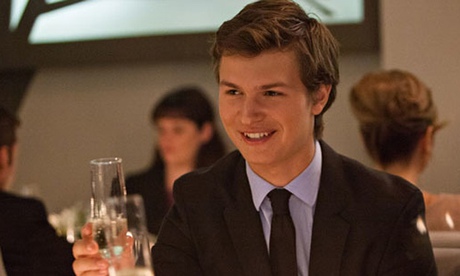
“It was really amazing to go see it with an audience. As you said, everyone was sobbing and I’ve never experienced something like this before. At first, it’s weird because you think it’s some sort of laughing, and you’re like, ‘What’s wrong with these people?’ No, everyone is crying.”


Ansel Elgort is what is traditionally called a triple-threat-he acts, dances, and sings. The 20-year-old New York native and theater-camp vet who started performing in ballet class at age 9 and crafts bass-thumping electronic dance tracks under the nom de musique Ansolo made his screen debut as pretty-boy high school jock Tommy Ross in last year's remake ofCarrie. He recently appeared in this spring's young-adult dystopian juggernaut Divergent, and in June gets leading-man status as Augustus Waters, one half of a pair of star-crossed, terminally ill teenage lovers in The Fault in Our Stars alongside fellow Divergent alum Shailene Woodley. His fourth movie, Jason Reitman's dramedy about modern love, Men, Women & Children, due out later this year, has him sharing the screen with Adam Sandler and Jennifer Garner. It's been a packed two years for Elgort, but he doesn't seem to be letting up soon.
COLLEEN KELSEY: You went to LaGuardia High School, the Fame school. Did you always want to act?
ANSEL ELGORT: When I was nine, I started doing ballet. That's when I knew that I was down to keep doing it. Eventually I came into acting and LaGuardia and straight play-acting turned into movies. I always did workshops. I would be at theater camp, doing shows, or after-school programs. Then I was doing shows in school. It was nonstop. I was never not in a show from ages 11 until 18. It was a great creative atmosphere but also a professional kind of atmosphere. When I finally went into the professional world, I felt ready. I was prepared for work.
KELSEY: What was the movie or play that made you want to be an actor?
ELGORT: Les Miz and Oklahoma! I was a big musical guy. Then I got into movies, watching old films my dad had, the old Elia Kazan movies, like On the Waterfront [1954]. It was those old movies, actually, that really got me started. Marlon Brando, Paul Newman—straight-up legends.
KELSEY: What was your first role?
ELGORT: The first show I did was The Nutcracker ballet. I was one of the kids who comes out in the beginning. In fifth grade, I did Oklahoma!, but I didn't get a leading role. I knew the whole play and could sing it already, but they were like, "The sixth-grader has to get the lead." I was really discouraged. Then I went to the Professional Performing Arts School.
KELSEY: Have you had any auditioning experiences that bring you back to that first rejection in Oklahoma!?
ELGORT: I guess so. I did seven auditions for Carrie. I just kept coming back and doing the same thing over and over again. I guess they just wanted to see if I was consistent. I was a total nobody. I wouldn't have hired me to be the lead in that movie either.
KELSEY: Really?
ELGORT: Not at first. Not off a couple auditions. I would want to see proof that I could do it.
KELSEY: You were in Carrie, a horror movie; Divergent, a sci-fi-action movie; and now you have The Fault in Our Stars, a fairly unusual love story. Have you diversified your acting skill set fairly quickly in your career?
ELGORT: It's not like I'm pulling a Christian Bale and getting really fuckin' skinny. I'm not playing a woman. Doing those kinds of things—that's diversity. I want to do that. I think that I could pull it off. I think that a theater background really helps with that.
KELSEY: Do you have actor role models?
ELGORT: Paul Newman. He could play a lot of different roles, even people who were villains, and no matter what, you love him. He was always such a relatable character—the smile, the blue eyes. Brando was just really real. James Dean was always a tortured soul. It's cool to look at the old guys. But when I'm looking at someone's career, I'm not trying to be, "Oh, whose do I want?" I don't really want anyone else's. I don't just act, and that's really important to me. I don't want to just be an actor forever. Right now I'm really into music. I want to score movies. I could be an actor first, but I don't only want to be an actor.
KELSEY: Who do you want to work with the most?
ELGORT: I think it would be ridiculous to work with Tom Hardy. I hear some crazy things about him, and he's also really good. I like the movie Warrior [2011] a lot and Gavin O'Connor, who directed it.
KELSEY: Have you ever been starstruck?
ELGORT: Less and less recently. It's so sad, you get less starstruck when you start realizing that it's not a big deal. I got starstruck not by someone who is famous, but by someone who's famous in the miniature painting community. When I was a kid, I used to paint miniatures. There were famous people in the miniature community from forums online. I went to some big event and I saw them in real life and I was so starstruck. So silly, right?
KELSEY: With The Fault in Our Stars, the book has such a cult following. Have you been aware of what people's expectations are for the movie?
ELGORT: Definitely. Especially since I'm really big on social media stuff. I get it firsthand, which I think is important. It's important to be there.
KELSEY: How close are you with your followers?
ELGORT: I've been Skyping with them, one on one, with people who have been winning a competition for my new EDM [electronic dance music] track "Unite." I have this raffle you can enter to promote the song. It's cool. They actually ask me a lot of questions about music. They really do care. And that's why social media is so important, because these kids, a lot of them had never known what electronic music was.
KELSEY: What's the event in history you wished you witnessed?
ELGORT: The '50s; the whole greaser time in Hollywood. I would have liked to have been there when they were like, [in an old-timey accent] "Oh, we're making pictures now that have sound and color!"
KELSEY: What actor, living or dead, would you want to play you in the movie of your life?
ELGORT: Paul Newman. I trust him.

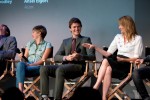
This movie is based on a beloved book by John Green. Has he seen the film and how does he feel about it?
Godfrey: He saw it very early on and was involved in the production, and loved it, thank goodness. But I think he knew all along from the screenplay to the casting that we were putting together a team that loved the book as deeply as its fans and that we were going to pay honor to it in whatever way we could.
The book is dedicated to a 16 year-old girl that died of cancer. Its authenticity is very important for the film. Can you talk about working with the cancer support groups and patients for the movie?
Boone: They validated the book for me in a lot of ways because they were so similar to Hazel and Gus. They were just funny, cynical, and irreverent, these wonderful dazzling human beings. It just made me believe more and more that this story had touched something that was real. They were a huge part of the process and gave so much to these actors. We were so happy to have them and tried to do some justice to what it’s like to go through something like this.
Some of the patients are in the movie?
Boone: Yes, everyone in the support group that Mike Birbiglia runs.
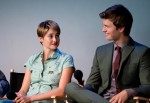
Woodley: One of the biggest things that you learn, or recognize, is that cancer doesn’t define a person. So it didn’t feel like we were working with a bunch of cancer patients, it felt like we were working with a bunch of teenagers that happened to be going through a really difficult time in their lives. Apart from that, everyone was the same, and that was really special and something that was very profound for me. What happens to us in life doesn’t define who we are and what our hearts feel. And that was a really beautiful thing to take away.
Elgort: Like Josh said, it does validate the way Hazel and Gus are in the story. It’s nice to see people in real life actually are like that because people with cancer aren’t just cancer; they’re just people that happen to have cancer. We wanted to bring those people to life.
Boone: All of those kids we met had their own things going on and their own love stories. Their illnesses didn’t seem to define them at all.
Dern: I’d just like to add that with the privilege – and perhaps the horror – of someone who got to play a mother in this circumstance, I quickly learned about the phenomenon around John Green, rightfully, since it’s such a brilliant and beautiful book. I also learned, as a parent who considers what I should shelter my child from, that we live in an age where 1 out of every 3 people have cancer. Instead of wondering if my 12 year-old should see this movie, I realized that this is a generation of kids who know this story intimately though their own families and their own friends. It’s really beautiful to be a part of a film that is reflecting a story they really need to talk about.
When I read the book I thought, what actress is going to pull off this role along with having tubes in her nose for two hours.
Woodley: First off, so many props to you guys [Godfrey, Boone] and to Fox for having the courage to show someone with tubes in her nose for the entire film, because that’s not an easy move to make in movies right now. I did meet with some people who had a hard time breathing with their lungs, and had to use oxygen, and we had a discussion of how far we were going to take it in the movie. If we were actually going to implement the breathing people go through in real life to cinema, it wouldn’t translate and the film would probably be four hours long. So we chose certain scenes to sort of play that up more. For me, emotionally, the book is so truthful, and the script was the most perfect adaptation of any book I’d ever read, I felt like our only job was to come to work and fully succumb to the truth of what these characters were going through. People ask what it’s like to play a cancer patient, and I tell them I wasn’t playing a cancer patient, I was playing a girl falling in love for the first time who happened to have cancer.
Ms. Dern, how did you approach your character and bring it to another level of emotion?
All roads seem to lead back to John Green and the gift his book gave us all. The thing that excited me is that I’ve never really played a parent or even a grown-up for that matter! So it was a perfect fit in that John wrote these two people that were kind of progressive hippies from the Peace Corps who fell in love and found themselves having a kid, and in sort of a modern progressive form of parenting, raised her like she was a buddy. I think from that energy of deep respect came Hazel’s very unique and honored and respected voice. Then, with her diagnosis, these people had to become real grown-ups and learn how to parent in a different way. They get to grow up with Hazel, and with her diagnosis. I was very moved by that.
Mr. Godfrey, can you talk about what first drew you into this book?
I read it the night the book came out. An executive at my company had read it as well, and we both called each other the next morning and were like, this is tremendous, it’s a transcendent love story. I bawled my eyes out through half of the book – sometimes as a parent, sometimes as a born-again teenager. It was transcendent and made me want to live a better life just by virtue of how they were facing their situation. So I thought, I have to believe that other people are going to respond the same way. It blew me away.
How did you navigate the different tones in the film?
Boone: We had a really wonderful script that was really funny with funny moments and we hired actors that understood the tone and could speak John’s language and translate it properly. A lot of it is just finding actors that have chemistry and letting it develop organically once they start working together.
How did you use supporting characters to bring humor into the movie?
Boone: Nat Wolff was in my first film, and he’s one of the funniest people I think any of us know. He keeps us all laughing and he has really wonderful improv skills that help with a role like this where he can add little touches. He brought so much humanity to it, so it was real but also funny. Mike Birbiglia was the same way. We looked at a lot of people to play the support group counselor – that was a hard role to cast. We’re very lucky [Screenwriter] Michael Weber recommended him to us.
Godfrey: We could make an entire movie out of his outtakes. It’s so funny cause we’re doing this scene and you had wanted everyone to be sort of quiet watching him, and there were real cancer patients in the scene, and they would just start laughing in the middle of it, so Mike was like, Oh okay I’ll go again!
Boone: He was fantastic. So much of it is casting. Mike Birbiglia brought so much to that role, just the way he phrases things and his idiosyncrasies. Those are the things you look for in people, little things you like about them, and hopefully you can exploit them without them knowing!